

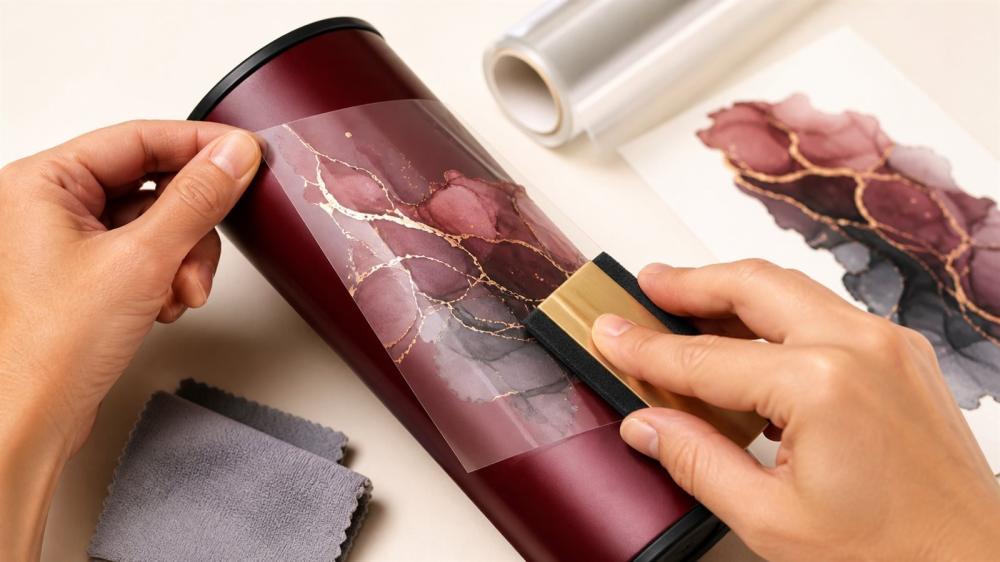
A UV DTF sticker is one of the easiest ways to customise hard surfaces: you print the design once, then transfer it onto a mug, a glass bottle or a product box in minutes, with no heat and no press. But the final result depends on how you apply it. Small steps such as cleaning the surface or the direction you press in make the difference between a smooth, bubble-free sticker and one that lifts at the edges a few days later. In this guide from ENJOY STORE, we explain how to apply a UV DTF sticker step by step, which surfaces suit it, and the common mistakes to avoid.
What Is a UV DTF Sticker and Why Does Application Matter?
A UV DTF sticker (UV Direct To Film) is a design printed with UV inks on a special film, then finished with an adhesive layer and a clear transfer layer. When you apply it, only the print moves onto the surface, so the design looks as if it was printed directly on the product, with no traditional sticker background, a raised feel and a glossy finish. Because the layer is thin and flexible, it needs a clean surface and gradual pressure so that every fine detail sticks, especially thin lines and small text.
The store offers several options depending on the size of your project, such as the custom A4 UV DTF sticker sheet for small quantities and testing, the A3 UV DTF sticker sheet for a larger design area, and individual UV DTF stickers in commercial quantities for shops and projects.
Step One: Make Sure the Surface Suits a UV DTF Sticker
UV DTF works best on hard, smooth surfaces. Its most popular uses include:
- Glass and ceramic mugs, cups and tea glasses.
- Glass bottles, perfume bottles and cosmetic containers.
- Rigid boxes, gift boxes and acrylic.
- Hard phone cases, laptops and office accessories.
- Smooth metal and plastic surfaces.
For very rough, flexible or highly curved surfaces, test a small piece first before ordering a full quantity. For fabrics and clothing there is a different technique, DTF fabric printing, because UV DTF stickers are made for hard surfaces, not garments.
Step Two: Prepare Your Tools
- A soft, lint-free cloth.
- A cleaner that suits the surface, such as isopropyl alcohol for glass and metal.
- A plastic card or a squeegee with a soft edge.
- Masking tape to mark the position if needed.
- A UV DTF sticker in the right size for the available area.
Choosing the right size matters a lot. A design larger than the flat part of the surface forces you to press over the curve, and that is where wrinkles and bubbles start. If you are not sure about the size, check our sticker size guide for packaging.
Step Three: How to Apply a UV DTF Sticker Without Bubbles
1. Clean and dry the surface completely
Wipe the surface with the cleaner to remove dust, oils and fingerprints, then let it dry fully. Any trace of grease or moisture weakens the adhesion and makes the edges lift later.
2. Position the design before removing the backing
Place the sticker on the surface while it still has its backing, and fix one edge with a strip of masking tape. This hinge method makes sure the design is straight and centred before the adhesive touches the surface.
3. Peel the backing slowly
Flip the sticker on the hinge and peel the backing paper slowly at a low angle, making sure every part of the design stays on the clear transfer layer. If a small part sticks to the backing, lay it back down, press it with your finger, then continue.
4. Press from the centre outwards
Lay the design on the surface and start pressing with the card from the centre towards the edges, using steady, overlapping strokes. Pressing in this direction pushes the air out instead of trapping it, and it is the main secret to applying a UV DTF sticker without bubbles.
5. Go over the fine details
After the general pass, go over small letters, thin lines and edges again with firmer pressure. You can also press small details with your finger to make sure they stick.
6. Remove the transfer layer at a low angle
Wait a moment, then slowly peel the clear transfer layer from one corner, keeping it close to the surface. If part of the design lifts with the layer, lay it back down and press that area again before you continue.
7. Let the sticker set
After application, avoid washing the item or rubbing it hard for about 24 hours so the layer can fully bond. After that, the sticker becomes more durable and more resistant to water and scratches in everyday use.
Applying a UV DTF Sticker on Curved Surfaces
Cylindrical mugs and bottles need extra care. Start from the middle of the design and press in one direction around the curve; do not press from both sides at once, or wrinkles will form in the middle. The stronger the curve, the better a smaller design, or one split into parts, will work compared with one wide design. If you are preparing labels for bottles, our article on UV DTF perfume bottle labels may help.
Common Mistakes When Applying UV DTF Stickers
- Applying it on a surface with dust, oil or moisture.
- Choosing a design larger than the flat area of the surface.
- Peeling the transfer layer too fast or at a high angle.
- Pressing from the edges inwards and trapping air in the middle.
- Ignoring the curve of the surface and not testing a piece before ordering a quantity.
- Washing or rubbing the item right after application.
How to Care for a UV DTF Sticker After Application
To keep the sticker looking good for longer, wash decorated mugs and pieces by hand with a soft sponge, avoid abrasive cleaners and direct scrubbing on the design, and do not expose it to high heat for long periods. On boxes, bottles and office items, wiping with a soft cloth is enough.
Test Before Ordering a Large Quantity
If you are planning UV DTF labels for your store's products, an occasion or corporate gifts, start with a small quantity on the same surface you will actually use, then approve the final size and design. We cover this step in test UV sticker samples before a bulk order, and we also recommend reading how to prepare print-ready artwork before sending your design.
For larger projects and print shops, we offer UV DTF stickers by the meter, 30 cm wide and UV DTF stickers by the meter, 60 cm wide, and you can browse every option in the UV DTF stickers category.
Related reading:
- UV DTF Car Stickers: Sizes, Application and Care
- How to Choose an Online Print Shop in Saudi Arabia: A Comparison Guide
UV DTF Sticker Application FAQ
Can UV DTF stickers be used on mugs?
Yes. They suit smooth glass and ceramic mugs, as long as you wash them gently by hand and avoid scrubbing directly on the design.
Can I use UV DTF on clothes?
No. UV DTF stickers are made for hard surfaces. For clothing and fabrics, use heat-applied DTF fabric printing.
Can I move the design after pressing it?
Usually not, because the adhesive grips immediately and trying to move it may damage the design. That is why you should set the position before removing the backing.
How do I avoid bubbles when applying a UV DTF sticker?
Clean and dry the surface, press gradually from the centre outwards with a soft tool, and do not remove the transfer layer until every detail has stuck.
Does a UV DTF sticker need heat or a press?
No. It is applied with hand pressure only, which makes it suitable for shops and individuals without any equipment.
Will there be a visible background after application?
No. Only the print transfers to the surface, so the design shows with its own outline and no traditional sticker background.
How long does it take to prepare a UV DTF order?
Orders are made to order, and production time depends on the quantity and design approval. Orders then ship to all cities in Saudi Arabia. See the Shipping and Fulfillment Policy for details.
At ENJOY STORE, we print custom UV DTF stickers for individuals, shops and companies across Saudi Arabia. If you have a design or an idea and need help choosing the right size, you can send us a custom request or a price quote request.
© The content of this article is owned by ENJOY STORE, custom printing and stickers – enjoystore.sa. Copying or republishing it without written permission is prohibited.