

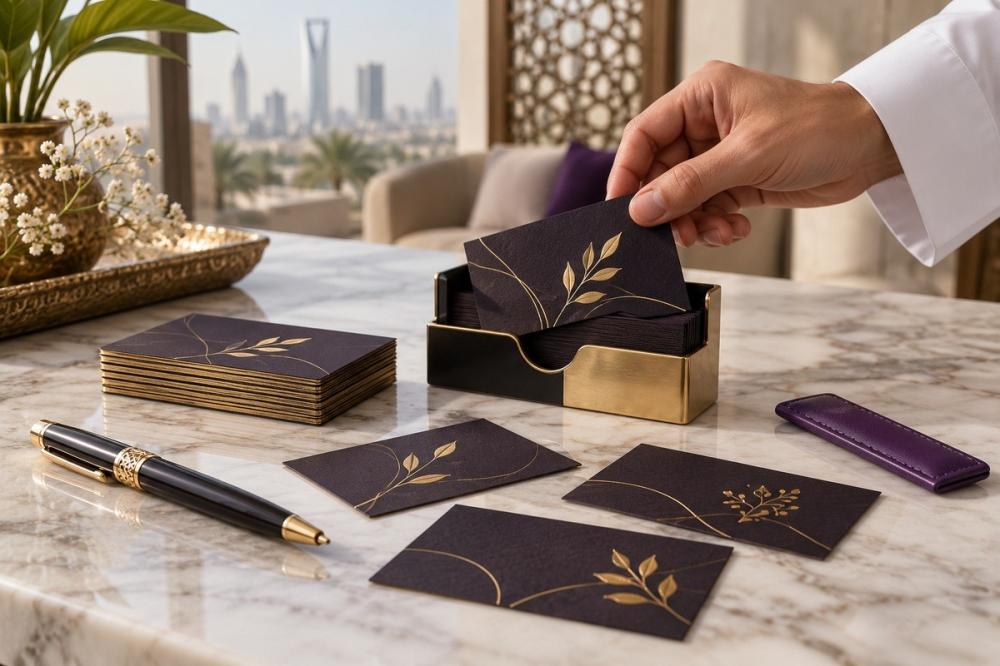
Despite digital communication, the business card remains one of the most important ways to introduce yourself and your business, especially at meetings, exhibitions and client visits. An elegant card leaves a professional impression from the first moment and makes it easy for clients to reach you later. In this ENJOY STORE guide we cover common business card sizes, card stocks and finishes, what to include and design tips.
Common Business Card Sizes
- Most common in Saudi Arabia and the Gulf: about 9 × 5 cm or 9 × 5.5 cm.
- European size: 8.5 × 5.5 cm.
- Square cards: about 6.5 × 6.5 cm for a different look.
The standard size is best because it fits wallets and card holders easily.
Materials and Finishes
Thick Card Stock
A heavy card (300 to 350 gsm or more) feels premium and does not bend easily.
Matte or Gloss Lamination
Matte gives a calm premium look and is easy to write on; gloss makes colours and photos pop.
Premium Touches
A raised glossy or gold logo, or rounded corners, makes your card stand out.
What to Include
- Name and job title.
- Company name and logo.
- Mobile and WhatsApp number.
- Email and website.
- Only your key social accounts.
- A QR code to your website or digital contact card.
- Address or city if needed.
Design Tips
- Make the name and phone number the clearest elements.
- Keep text at least 7 to 8 pt.
- Use the same brand colours across cards, stamps and stationery.
- Use the back for the logo, a QR code or a short list of services.
- Keep a 3 to 5 mm safe margin from the trim edge.
- Check numbers and email letter by letter before approval.
See how to prepare print-ready artwork and how to prepare your logo for printing.
Business Cards for a Whole Team
For several employees, send an organised sheet of names, titles and numbers, and keep one design with only the details changing. For large orders, contact our corporate and wholesale services.
Complete Your Brand Identity
Business cards are part of a complete identity with stamps, brochures, thank-you cards and logo stickers. Find cards and prints in the paper printing category, and read the paper prints guide for businesses.
Order Your Business Cards
Send your details, design or logo and quantity through a custom request, and we will send a proof before printing.
Why Business Cards Still Matter in Saudi Arabia
In Saudi business culture personal relationships drive deals, so the business card keeps its place at meetings, exhibitions, conferences and client visits. Exchanging cards signals seriousness and ensures the other party has your correct details. An elegant card reflects your company's quality before the client sees your product, a mini version of your brand in their pocket.
Common Business Card Types
- Classic: card stock with a simple design in brand colours.
- Premium: thicker stock with matte finish and a gold or raised logo.
- Shaped: square, round or rounded corners to stand out.
- Double-sided: details on one side, logo, QR code or services on the other.
Browse cards and prints in the paper printing category.
Business Cards by Profession
Doctors and Clinics
A calm design with name, specialty, appointment number, location and a booking QR code.
Lawyers and Consultants
A formal design with classic fonts and dark colours.
Designers and Creatives
Unusual shapes, bold colours and a QR code to the portfolio.
Real Estate and Sales
A small photo and a large mobile and WhatsApp number for quick contact.
Online Stores and Home Businesses
Logo, handles and website, doubling as a thank-you card in orders. Read the store identity stickers guide.
Contractors and Maintenance
The core service and emergency number clearly, in strong colours.
Printed and Digital Cards: Combine Both
Digital business cards shared by phone complement printed cards rather than replacing them. The best approach today is an elegant printed card with a QR code leading to a digital card or profile page, so clients get a tangible impression and can save your details in one tap. Test the QR code before printing and keep the page up to date.
Choosing Fonts and Colours
- Use the same brand font as your logo and website.
- No more than two fonts per card.
- Make the name larger and bold, details smaller but clear.
- One main brand colour plus one accent.
- Ensure contrast, especially for numbers.
Horizontal or Vertical?
Horizontal cards are most common and easy to read; vertical cards feel modern and suit designers, stores and young brands. Choose the orientation that fits your information without shrinking the text.
How Many Cards to Order?
A medium quantity lasts an individual several months, while sales reps and exhibitors need more. Avoid huge runs if your details may change soon, and order for the whole team at once with one design.
Common Business Card Mistakes
- Wrong phone number or email.
- Tiny text or faded colours.
- Every account and number crammed in.
- A low-resolution logo.
- Thin paper that bends quickly.
- A design that does not match your other prints.
Summary
A successful business card is simple, clear and on-brand: standard size, thick stock, the right finish, essential details and a QR code linking print to digital. Matching your team's cards with stamps, brochures and logo stickers builds a complete professional identity. Read the new business print guide.
Special Finishes in Detail
Soft Matte
A soft, premium feel that reduces glare and can be written on, the favourite for most companies.
Gloss
Makes colours and photos vivid, ideal for restaurants, real estate and photographers.
Raised Logo Layer
A raised gloss layer on the logo only, against a matte card, for a memorable contrast.
Gold or Silver Touch
On the logo or name for a luxury feel suited to jewellery, perfume, hotels and executives.
Custom Cut and Rounded Corners
Rounded corners look modern and resist wear; custom shapes reflect your business.
Business Card Etiquette
Hand your card with the right hand or both hands, facing the recipient, and take a moment to read cards you receive. Keep cards in a clean holder and carry enough to meetings and exhibitions.
Business Cards at Exhibitions
To stay memorable among dozens of cards, make yours distinctive in shape or finish, write a short handwritten note on the back about what you discussed, and pair it with a brochure and a clear roll-up. Follow up within a few days after the event.
Preparing a Business Card File Step by Step
- Create the file at final size plus a 3 mm bleed on each side.
- Use CMYK and 300 DPI images.
- Keep all text and the logo inside the safe area.
- Outline or embed fonts.
- Put each side on its own page for double-sided cards.
- Export a high-quality PDF.
- Check names, numbers and email letter by letter.
Cards With Many Names Without Mistakes
For a whole team, prepare a sheet with clear columns: Arabic name, English name, title, mobile and email. Have each employee check their row and use one format for numbers.
When to Redesign Your Card
- When the logo or identity changes.
- When numbers, address or website change.
- After a promotion or title change.
- When the design no longer reflects your service level.
More Business Card Questions
Can a card be bilingual?
Yes, Arabic on one side and English on the other, or both balanced on one side.
Is thicker always better?
Thicker stock feels higher quality, but clear design and correct details matter most.
Advice From the ENJOY STORE Team
The most common business card issue is a wrong digit or email letter found after printing. Review the proof calmly: call the number, email the address and scan the QR code before approving. If details may change soon, order a medium quantity and reorder later with the saved design.
Treat your business card as a real sales tool: add what prompts contact, such as a standout service, an offer QR code or a short value statement. Every card you hand out opens a door to a new opportunity.
Related reading:
- How to Write a Thank-You Card That Encourages Repeat Purchases
- Using QR Codes Effectively in Print and Packaging
- Types of Stamps and How to Choose a Company Stamp
Business Cards FAQ
Can both sides be printed?
Yes, and it is recommended to use the space for your logo or a QR code.
Is a business card the same as a visiting card?
Yes, they are different names for the same product.
Do you design business cards?
Yes. Choose the design service and send your logo, details and brand colours.
© The content of this article is owned by ENJOY STORE, custom printing and stickers – enjoystore.sa. Copying or republishing it without written permission is prohibited.