

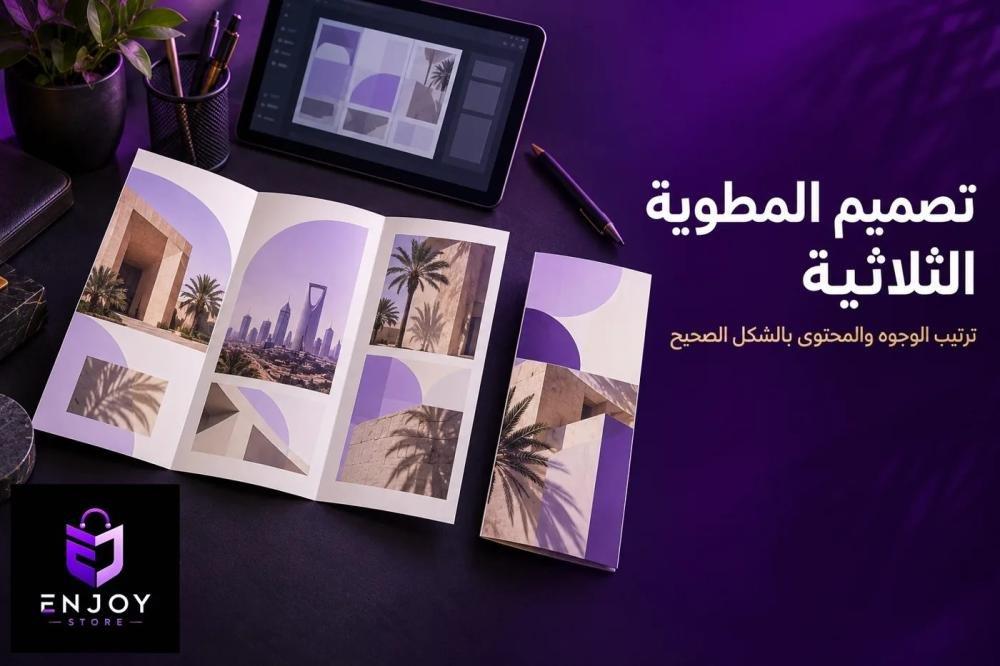
The tri-fold brochure is one of the most popular printed marketing pieces, but its success depends on more than colours. It depends on panel order and content. Readers do not see all six panels at once; they open the brochure in stages, and each stage should lead to the next. This guide walks you through tri-fold brochure design step by step: the panel map, what to write on each panel, sizes and safety margins, and the mistakes that make a brochure look unprofessional even with a beautiful design.
Understand the tri-fold format
A tri-fold is an A4 sheet (21 × 29.7 cm) printed on both sides and folded twice, giving a folded size of about 9.9 × 21 cm. You get an outside with three panels and an inside with three panels. Not sure a tri-fold suits your content? Read brochures vs flyers first.
The six-panel map
English brochures read left to right, while Arabic brochures are mirrored. Here is the most common roll-fold layout for an English brochure:
| Side | Left panel | Middle panel | Right panel |
|---|---|---|---|
| Outside | Inside flap (folds in) | Back cover | Front cover |
| Inside | Inside panel 1 | Inside panel 2 | Inside panel 3 |
For an Arabic brochure, mirror the outside: front cover on the left, back cover in the middle and the inside flap on the right. A quick trick: fold a plain A4 sheet into three and label each panel with a pen before you design. It prevents the most common mistake, placing the cover in the wrong panel.
What to put on each panel
1. Front cover: why should they open it?
Its only job is to make people open the brochure. Use your logo, a short benefit-led headline and one strong image. Avoid crowding it with text or numbers. For a sharp logo, see preparing your logo for printing.
2. Inside flap: the first thing read after the cover
When the reader opens the cover, this panel appears first. Use it for a teaser, your key offer, or the customer's problem and your solution. Many designers neglect it, yet it is one of the most important panels.
3. The three inside panels: the heart of the brochure
When fully opened, the three inside panels are seen together as one spread. Use them to present services or products in an organised way, such as one panel per service, or a story from about us to services to why choose us. Give each panel a clear heading.
4. Back cover: contact details and call to action
The middle outside panel is the back cover and often the last thing seen. Add your WhatsApp number, website, social accounts and a QR code that leads straight to ordering. See using QR codes in print.
Sizes and safety margins
- File size: landscape A4 (29.7 × 21 cm) per side, two pages in one PDF.
- Panel width: about 9.9 cm; the inside flap is ideally about 2 mm narrower so it folds in neatly.
- Bleed: add 3 mm around the file if the background runs to the edge.
- Safety margin: keep important text at least 5 mm from edges and fold lines.
- Resolution: images at 300 DPI in CMYK.
If you are unsure about panel sizes, message us on WhatsApp 0559899141 before you start designing. More technical details in preparing print-ready artwork.
Design rules for a clearer brochure
- One or two fonts: one for headings and one for body text, at least 9 to 10 pt.
- White space: do not fill every centimetre.
- Brand colours: keep them consistent across all panels.
- No text on fold lines: folding can cut words or crack dark colours.
- Real photos: your own products or venue are more convincing than stock images.
Content examples by business type
Clinic or medical centre
Cover: logo and a care message. Inside flap: specialities in brief. Inside: one panel per department. Back: opening hours, booking number and a QR code.
Services or contracting company
Cover: logo and tagline. Inside flap: key achievement numbers. Inside: about us, services and projects. Back: contact details and branches in Riyadh, Jeddah or Dammam.
Restaurant or café
Cover: logo and a hero dish. Inside flap: weekly offer. Inside: menu sections. Back: delivery number and an ordering QR code. For a menu with a thicker cover, see the folded A5 menu.
Paper and finishing
150 gsm is the most popular weight for everyday brochures, and 180 gsm and up suits premium profiles. We crease heavier paper before folding for a clean fold. See the paper weight guide, and if the brochure will be handled a lot, read do you need lamination for your prints?
Checklist before approving the proof
- The front cover sits in the right panel when folded.
- WhatsApp number and website are correct, and the QR code works on a phone.
- No important text sits on fold lines or near the edges.
- Prices and offers are still valid; if they change often, use a QR code instead.
- Spelling is checked and text is readable at arm's length.
FAQ
What is the folded size of a tri-fold brochure?
About 9.9 × 21 cm, made from an A4 sheet folded twice.
Where does the cover go in an Arabic tri-fold?
On the left panel of the outside, with the back cover in the middle and the inside flap on the right.
How many pages should my design file have?
Two: the outside and the inside, each as landscape A4 in one PDF.
Do the brochures arrive folded?
Yes, we fold them after printing so they arrive ready to hand out.
Do you send a proof before printing?
Yes, we send a digital proof for approval, so check the panel order carefully.
Can you design the brochure for me?
Yes, we offer a paid design service you can add to your order.
How long does production take?
1 to 3 working days after design approval, with fast shipping to all cities in Saudi Arabia.
Ready to print your tri-fold?
Once your panels and file are ready, order from tri-fold brochure printing and choose quantity, paper weight and lamination; the price appears instantly based on your selected options on the product page. If you have less content, a bi-fold brochure may suit you better, or complete your printed identity with business cards.